
The average surface temperature on Earth is about 15°C (59°F). There are however some remarkable temperature highs and lows. Let’s learn what are the hottest and coldest recorded temperatures on Earth.
Hottest and coldest recorded temperatures
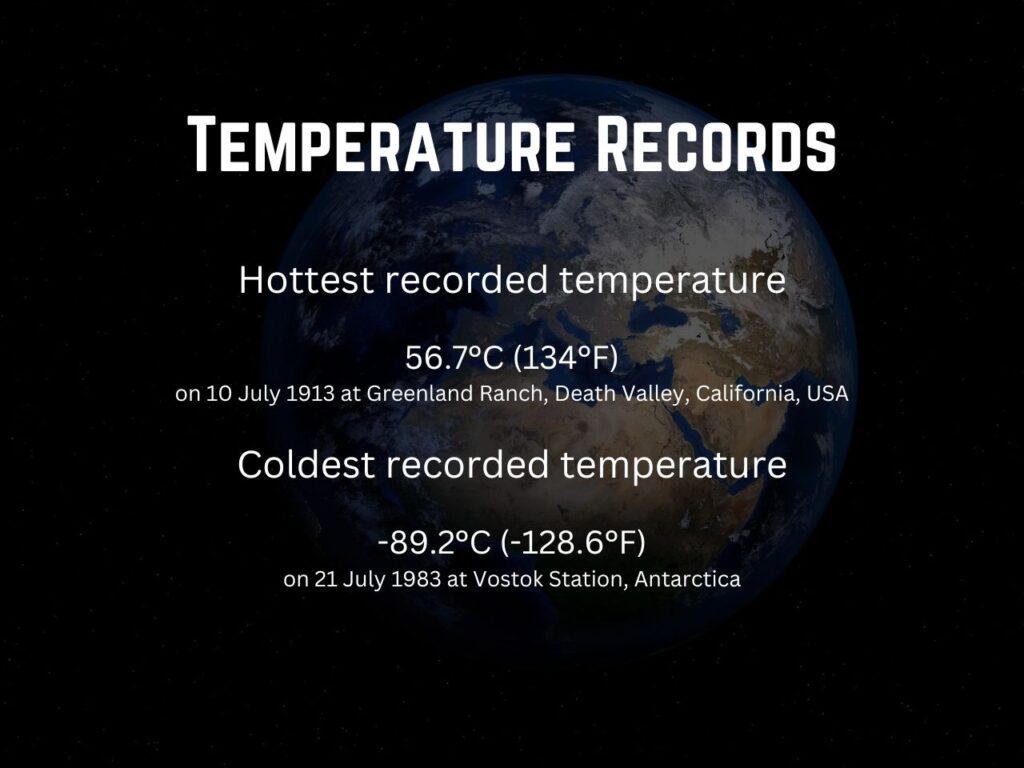
According to World Meteorological Organisation, the hottest recorded temperature on Earth is 56.7°C (134°F). It was measured on 10 July 1913 at Greenland Ranch (now Furnace Creek), Death Valley, California, USA.
The coldest recorded temperature on Earth is -89.2°C (-128.6°F), measured on 21 July 1983 at Vostok Station, in Antarctica.
Did you know?
For 90 years, the official world record for the hottest recorded temperature belonged to El Azizia, Libya, which recorded a sweltering 58°C (136.4°F) in 1922. However, in 2012, the World Meteorological Organization (WMO) conducted an investigation and stripped Libya of the title. Investigators concluded that an inexperienced observer had likely misread the station’s thermometer, restoring Death Valley’s 1913 reading as the official world record. The equipment used at El Azizia was also considered outdated and unreliable.
Doubts about the reading had emerged because it was inconsistent with later measurements taken at the same site and at nearby weather stations.
Can humans survive the hottest and coldest temperatures recorded on Earth?
Humans cannot survive the most extreme temperatures on Earth without protection. In extremely hot places such as Death Valley, prolonged exposure can lead to dehydration, heatstroke, and organ failure. In extremely cold environments like Antarctica’s Vostok Station, exposed skin can freeze within seconds, causing severe frostbite and hypothermia. However, with specialized clothing, shelter, and modern technology, people are able to live and work in some of the harshest climates on the planet.