
Any scenic view feels incomplete without clouds drifting in the background. But how do clouds actually form? Ever wondered? Let’s find out.
How do clouds form?
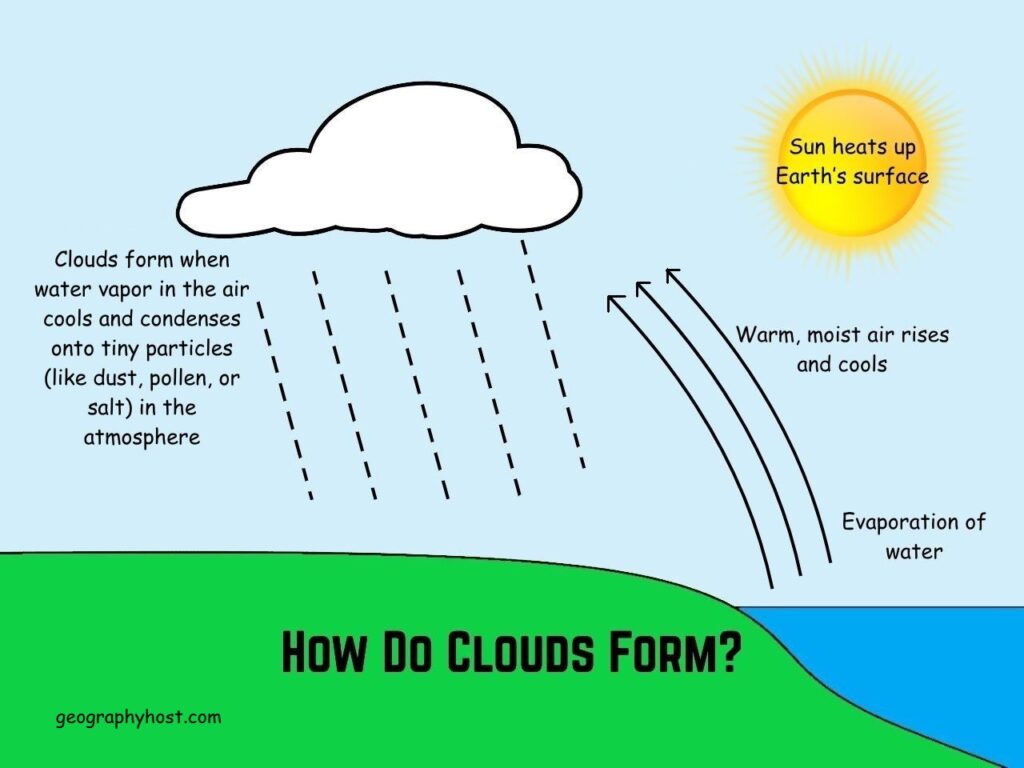
- When the Sun heats the Earth, water evaporates to form water vapor.
- The warm, moist air then rises into the atmosphere (hot air being lighter rises).
- As the saturated air (holding all the water vapor it can) rises, it cools. The water vapor then changes to either liquid water (through condensation) or solid ice (through deposition), depending on the temperature.
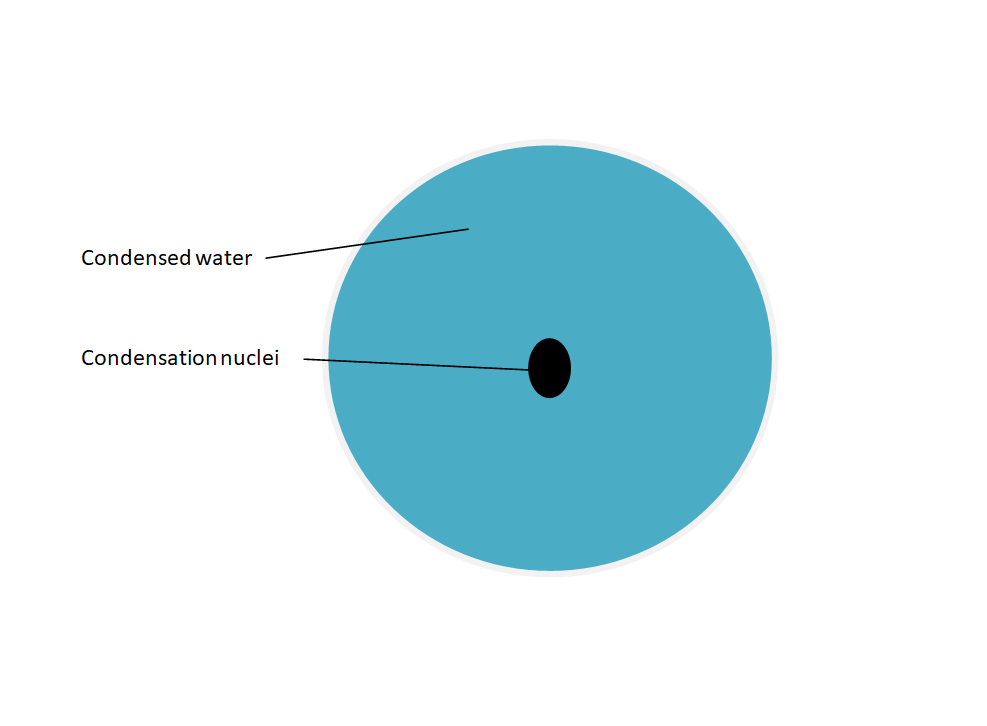
- The water vapor condenses onto tiny particles suspended in the air known as condensation nuclei e.g. dust, salt, pollen, etc. This forms tiny water droplets. In colder conditions, ice crystals form instead.
- These droplets/ice crystals merge together to form bigger droplets/ice crystals .
- Cloud is nothing but a large accumulation of these water droplets or ice crystals.
This is just a basic explanation of cloud formation. There are various factors involved in the process. Moreover, there are different types of clouds and they are formed at a wide range of altitudes.
(Also read: Types of clouds | Cirrus, Cirrostratus, Cirrocumulus, etc.)
Fun facts about clouds
- Larger clouds can weigh millions of tons.
- The cloud cover in the sky is expressed in eighths. 4/8 is a half-covered sky, 8/8 is a fully covered sky, 2/8 is a quarter-covered sky.
- The fog at ground level is a low-lying cloud.
- Nimbostratus clouds are also known as rain clouds.
- Cumulonimbus clouds are also known as thunder clouds.
- Clouds are a common feature on many planets and moons in our solar system and beyond.
Read more