
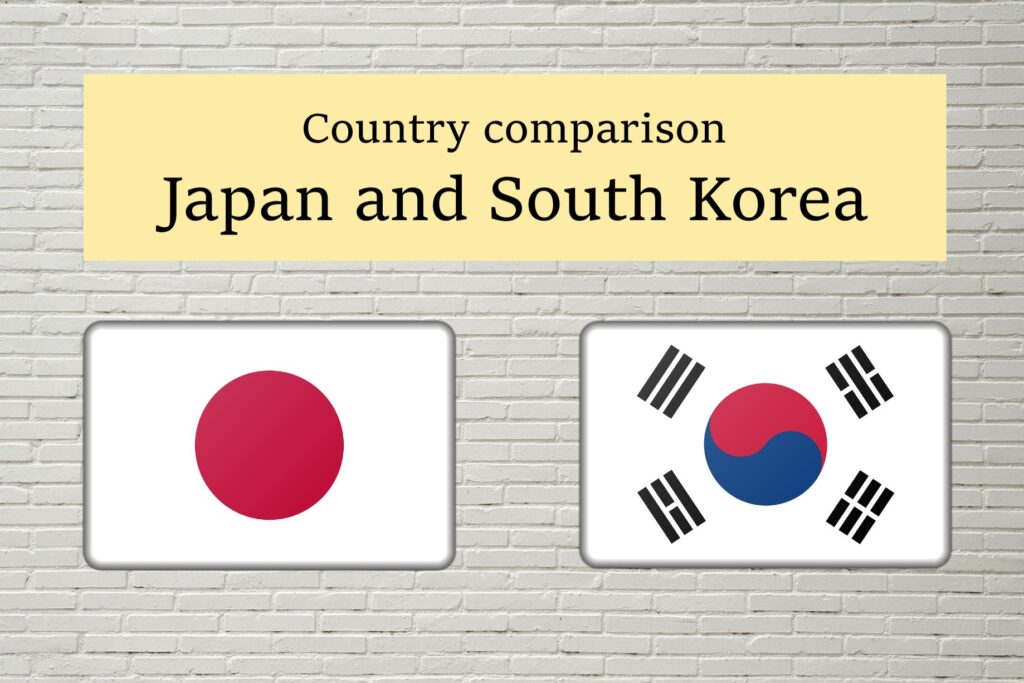
The following is a comparison between Japan and South Korea, two developed countries in East Asia. Let’s read.
Japan and South Korea – country comparison
GDP comparison
Japan has a larger GDP, while South Korea has a higher GDP per capita. Both countries have highly developed economies with major strengths in manufacturing, technology, automotive production, and electronics. The table below compares the GDP and GDP per capita of Japan and South Korea.
| 2025 (IMF) | Japan | South Korea |
|---|---|---|
| Currency | Japanese Yen | South Korean won |
| GDP (nominal, USD) | $4.44 trillion | $1.87 trillion |
| GDP per capita (nominal, USD) | $35.97 thousand | $36.23 thousand |
| GDP (PPP, international $) | $7.01 trillion | $3.38 trillion |
| GDP per capita (PPP, international $) | $56.85 thousand | $65.4 thousand |
Source: International Monetary Fund (IMF)
Population
Japan has a larger population than South Korea. However, South Korea is more densely populated. The table below compares the population, total fertility rate (TFR), and the percentage of the population in different age groups in the two countries.
| 2025 estimate | Japan | South Korea |
|---|---|---|
| Population | 123.1 million | 51.7 million |
| Population aged 0-14 | 11% | 10% |
| Population aged 15-64 | 59% | 69.7% |
| Population aged 65 and older | 30% | 20.2% |
| Total fertility rate, per woman | 1.2 | 0.8 |
Source: United Nations Population Fund (UNFPA)
Life
| Japan | South Korea | |
|---|---|---|
| Life expectancy at birth (2023/UN) | 84.71 | 84.33 |
| Human Development Index rank (2023) | 23rd | 20th |
| Human Development Index value | 0.925 | 0.937 |
Top 3 largest cities by population
| Rank | Japan | South Korea |
|---|---|---|
| 1 | Tokyo | Seoul |
| 2 | Yokohama | Busan |
| 3 | Osaka | Incheon |
Overview
Japan has a larger area than South Korea. In fact, it is more than 3.7 times larger.
| Japan | South Korea (Republic of Korea) | |
|---|---|---|
| Area | approximately 378,000 sq km | approximately 100,350 sq km |
| Population | 123.1 million (2025 estimate) | 51.7 million (2025 estimate) |
| Capital city | Tokyo | Seoul |
| Largest city | Tokyo | Seoul |
| Largest metropolitan area | Greater Tokyo Area | Seoul Capital Area |
| Most spoken language | Japanese | Korean |
| Most popular sport | Baseball | Baseball and football (soccer) |
| National tree | Cherry blossom | Korean red pine |
| National bird | Green pheasant | Korean magpie |
| National animal | – | Tiger |
(Also read: 10 interesting facts about Japan)
Geography
| Japan | South Korea | |
|---|---|---|
| Continent | Asia | Asia |
| Forest cover (2023) | 68.4% | 64.1% |
| Total number of time zones | 1 | 1 |
| Highest mountain | Mount Fuji (3,776 m/12,388 ft) | Hallasan (1,947 m/6,388 ft) |
| Major rivers | Shinano River, Tone River, Ishikari River, Teshio River, Kitakami River, etc. | Nakdong River, Geum River, Yeongsan River, Han River, Seomjin River, etc. |
| Number of islands | over 14,000 | over 3,300 |
| Largest island | Honshu Island | Jeju Island |
Tourism
| Japan | South Korea | |
|---|---|---|
| International tourist arrivals | 36.9 million (2024) | 16.4 million (2024) |
| Number of UNESCO World Heritage Sites | 27 | 17 |
| Popular places to visit | Tokyo, Kyoto, Osaka, Nara, Mount Fuji, Sapporo, Okinawa, etc. | Seoul, Busan, Jeju Island, Incheon, Gyeongju, Andong, etc. |
| Busiest airport | Haneda Airport, Tokyo | Incheon International Airport |
Read more