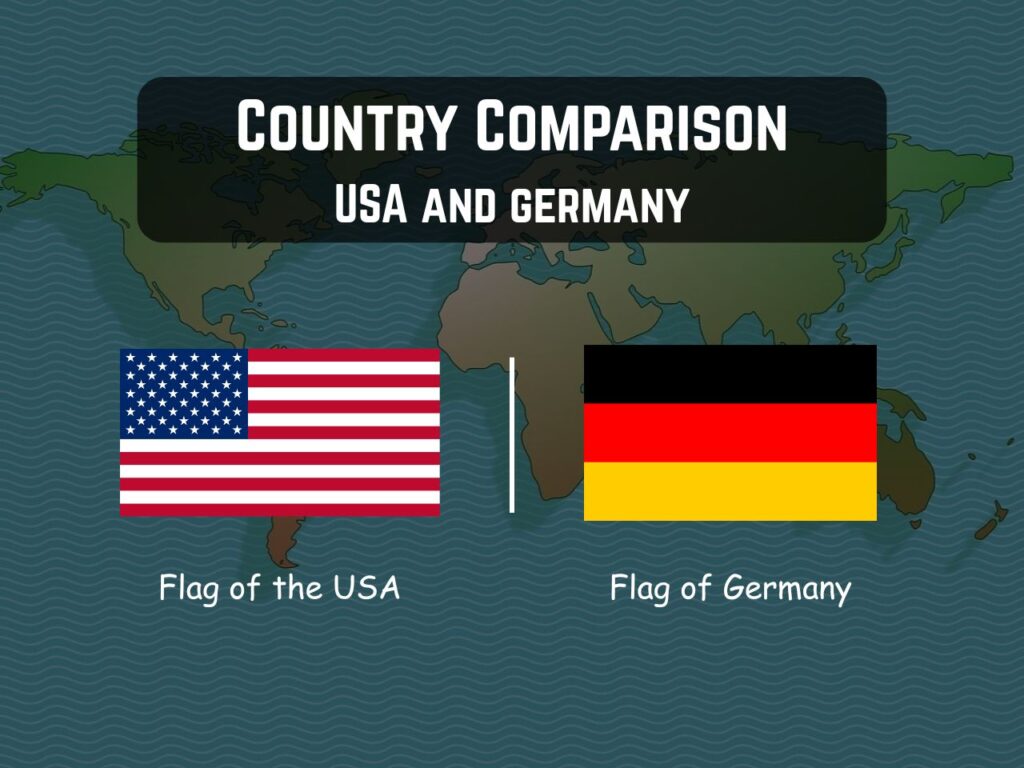
The following is a comparison between the United States of America (USA) and Germany, two large economies of the world. Let’s read.
USA and Germany – country comparison
GDP
The United States has both a larger GDP and a higher GDP per capita than Germany. It is the world’s largest economy by nominal GDP, with major strengths in technology, finance, manufacturing, and healthcare. Germany also has a highly developed economy with major strengths in manufacturing, automotive manufacturing, chemicals and pharmaceuticals, and services. The table below compares the GDP and GDP per capita of the United States and Germany.
| 2025 (IMF) | USA | Germany |
|---|---|---|
| Currency | United States Dollar | Euro |
| GDP (nominal, USD) | $30.77 trillion | $5.05 trillion |
| GDP per capita (nominal, USD) | $89.99 thousand | $60.44 thousand |
| GDP (PPP, international $) | $30.77 trillion | $6.18 trillion |
| GDP per capita (PPP, international $) | $89.99 thousand | $74 thousand |
Source: International Monetary Fund (IMF)
Population
The United States has a larger population than Germany. However, Germany is more densely populated. The table below compares the population, total fertility rate (TFR), and the percentage of the population in different age groups in the two countries.
| 2025 estimate | USA | Germany |
|---|---|---|
| Population | 347.3 million | 84.1 million |
| Population aged 0-14 | 17% | 14% |
| Population aged 15-64 | 65% | 62% |
| Population aged 65 and older | 18% | 24% |
| Total fertility rate, per woman | 1.6 | 1.5 |
Source: United Nations Population Fund (UNFPA)
Life
| USA | Germany | |
|---|---|---|
| Life expectancy at birth (2023/UN) | 79.3 | 81.38 |
| Human Development Index rank (2023) | 17th | 5th |
| Human Development Index value | 0.938 | 0.959 |
Overview
The United States is approximately 28 times larger than Germany in terms of total area. It is the third-largest country in the world by total area, while Germany is the seventh-largest country in Europe.
| USA | Germany | |
|---|---|---|
| Area | approximately 9.8 million sq km | approximately 357,600 sq km |
| Population | 347.3 million (2025 estimate) | 84.1 million (2025 estimate) |
| Capital city | Washington, D.C. | Berlin |
| Largest city | New York City | Berlin |
| Largest metropolitan area | New York metropolitan area (Tri-State area) | Rhine-Ruhr metropolitan region |
| Most spoken language | English | German |
| Most popular sport | American football | Football (Soccer) |
Geography
| USA | Germany | |
|---|---|---|
| Continent | North America | Europe |
| Forest cover (2023) | 33.9% | 32.7% |
| Total number of time zones | 11 | 1 |
| Highest mountain | Denali/Mount McKinley (6,190 m/20,310 ft) | Zugspitze (2,962 m/9,718 ft) |
| Largest island | Hawaii island (10,430 sq km) | Rügen (926 sq km) |
| Largest lake | Lake Superior (shared with Canada); Lake Michigan (entirely within the United States) | Lake Constance |
| National tree | Oak | Oak |
| National animal | Bald eagle (national bird), America bison (national mammal) | Eagle |
(Also read: USA and Australia – country comparison | USA vs Australia)
Tourism
| USA | Germany | |
|---|---|---|
| International tourist arrivals | 72.4 million (2024) | 37.5 million (2024) |
| Number of UNESCO World Heritage Sites | 27 | 55 |
| Popular places to visit | New York City, Los Angeles, San Francisco, Yellowstone National Park, Chicago, Yosemite National Park, Miami, Las Vegas, etc. | Berlin, Munich, Frankfurt, Hamburg, Cologne, Dresden, Nuremberg, Düsseldorf, etc. |
| Busiest airport | Hartsfield-Jackson Atlanta International Airport | Frankfurt Airport |